

Smart Money Concepts — what every box, line, and label means
Can't tell what's on the chart? Decode every order block, fair value gap, and structure break — what's actionable, what's just context.
Enable it from the chart’s fx Indicators dialog as “Smart Money Concepts”.
Read it in 30 seconds
- Boxes are zones of interest, not lines — a blue box is a demand (potential support) zone, a dark-red box is a supply (potential resistance) zone.
- Solid break lines are SWING (higher-timeframe) structure; dashed lines are INTERNAL (smaller) structure. BOS = trend continues, CHoCH = trend may be turning.
- Green/red FVG boxes mark a 3-bar imbalance price often revisits — context, not a trade trigger.
- Every zone is an area to watch for a reaction, never a guaranteed reversal or an entry by itself.
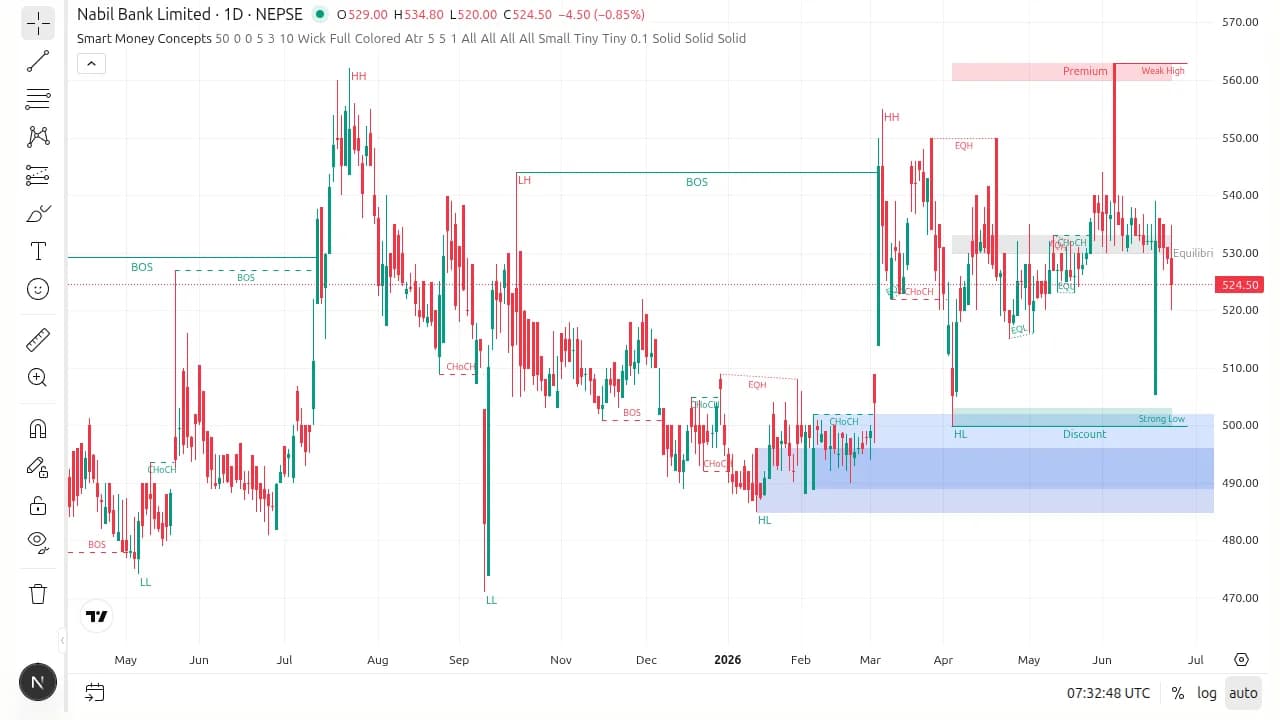
What each element means
- Bullish (demand) order blockActionable
The last down-candle before a bullish break. A zone where buying stepped in — watch for support on a revisit.
- Bearish (supply) order blockActionable
The last up-candle before a bearish break. A zone where selling stepped in — watch for resistance on a revisit.
- Internal demand order blockInformational
A smaller-structure demand zone (lighter blue). Same idea as a swing OB but from internal structure — weaker, more frequent.
- Internal supply order blockInformational
A smaller-structure supply zone (salmon). Weaker and more frequent than a swing supply OB.
- Bullish fair value gapInformational
A 3-bar gap left by a fast up-move (neon green). Price often returns to fill it before continuing.
- Bearish fair value gapInformational
A 3-bar gap left by a fast down-move (red). Price often returns to fill it.
- Swing structure break (BOS / CHoCH)Informational
A solid line marking a higher-timeframe break. BOS = the trend continued past the last swing; CHoCH = the first break against the trend (a possible turn). Green when bullish, red when bearish.
- Swing points (HH / HL / LH / LL)Informational
Labels at confirmed pivots: Higher High, Higher Low, Lower High, Lower Low — the skeleton of the trend.
- Discount zoneActionable
The lower portion of the recent swing range (green) — relatively cheap. Buyers tend to favour this half.
- EquilibriumInformational
The midpoint (gray) of the swing range — the 50% level dividing premium from discount.
- Trend-colored candlesInformational
When enabled, candles tint to the internal trend bias — green while internal structure is bullish, red while bearish. A quick at-a-glance bias, not a signal.
Swatches show the indicator’s default colors. If you’ve recolored it (or switched to Monochrome), your chart will differ.
What it tells you
- Where price previously flipped direction (order blocks) and where it moved too fast to trade fairly (FVGs) — the zones it tends to react at.
- The current trend skeleton: BOS confirms continuation, CHoCH warns of a possible reversal.
- Whether price is currently expensive (premium) or cheap (discount) relative to the latest swing range.
What it does not tell you
- It does not tell you to buy or sell — a zone is an area of interest, not an entry.
- A zone is not a guaranteed reversal; price can blow straight through an order block or FVG.
- Premium/discount is relative to the recent swing range, not an absolute 'overvalued/undervalued' call.
- Internal (dashed/lighter) structure is noisier than swing (solid/darker) — don't weight them equally.
Common misreads
- Treating an order block as a thin support/resistance line instead of a zone to watch for a reaction.
- Reading a green fair value gap as a 'buy' signal — it marks an imbalance, not a direction to trade.
- Confusing an internal break (dashed) with a swing break (solid) and over-trusting the smaller one.
- Mistaking BOS (continuation) for CHoCH (possible reversal) — the label tells you which.
Worked examples
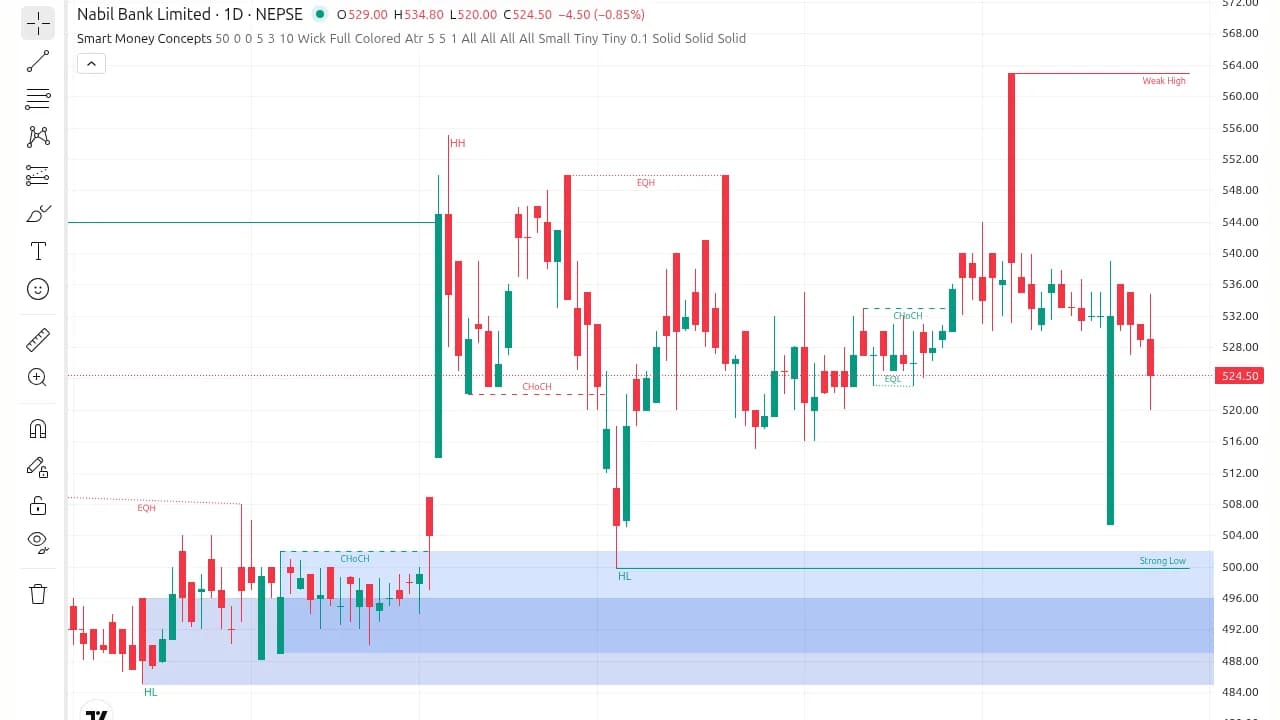
Price spent weeks inside the blue discount zone, printed a CHoCH, then broke up to a higher high — the cheap half of the range did its job.
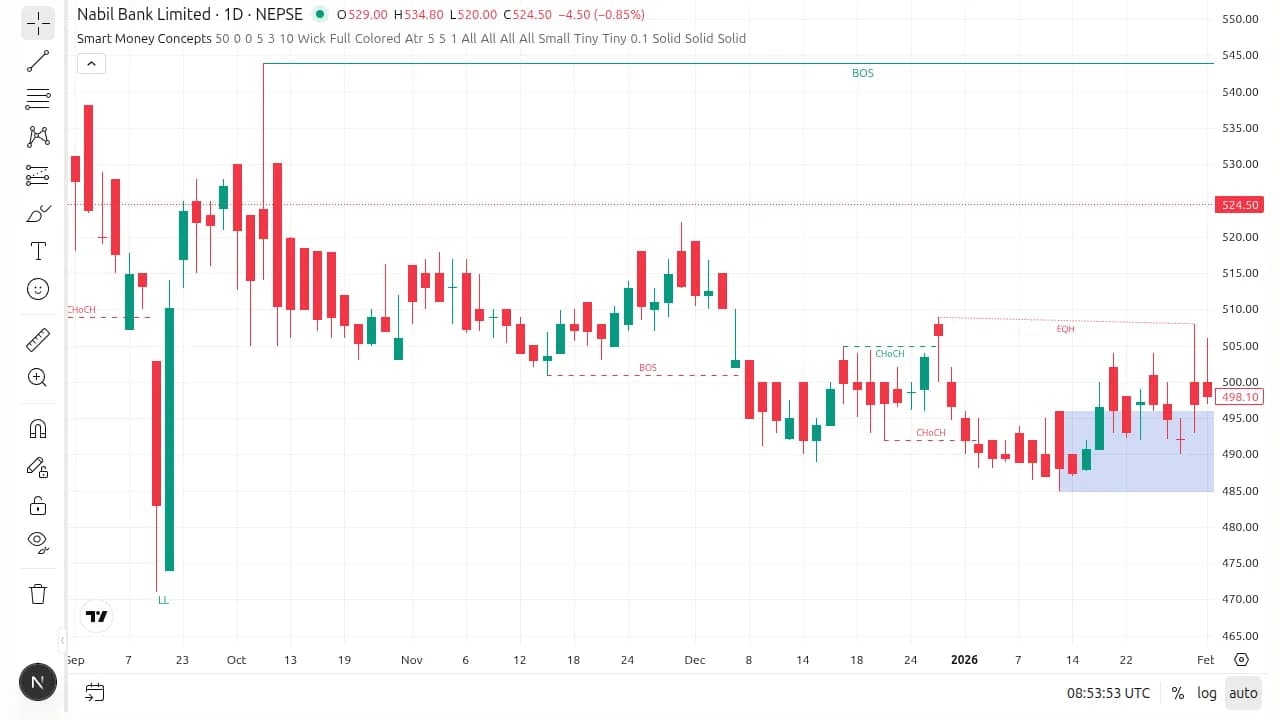
A sideways range where internal CHoCH flipped repeatedly and an EQH got swept — no clean trend. Internal breaks are noisier than swing breaks; weight them less.
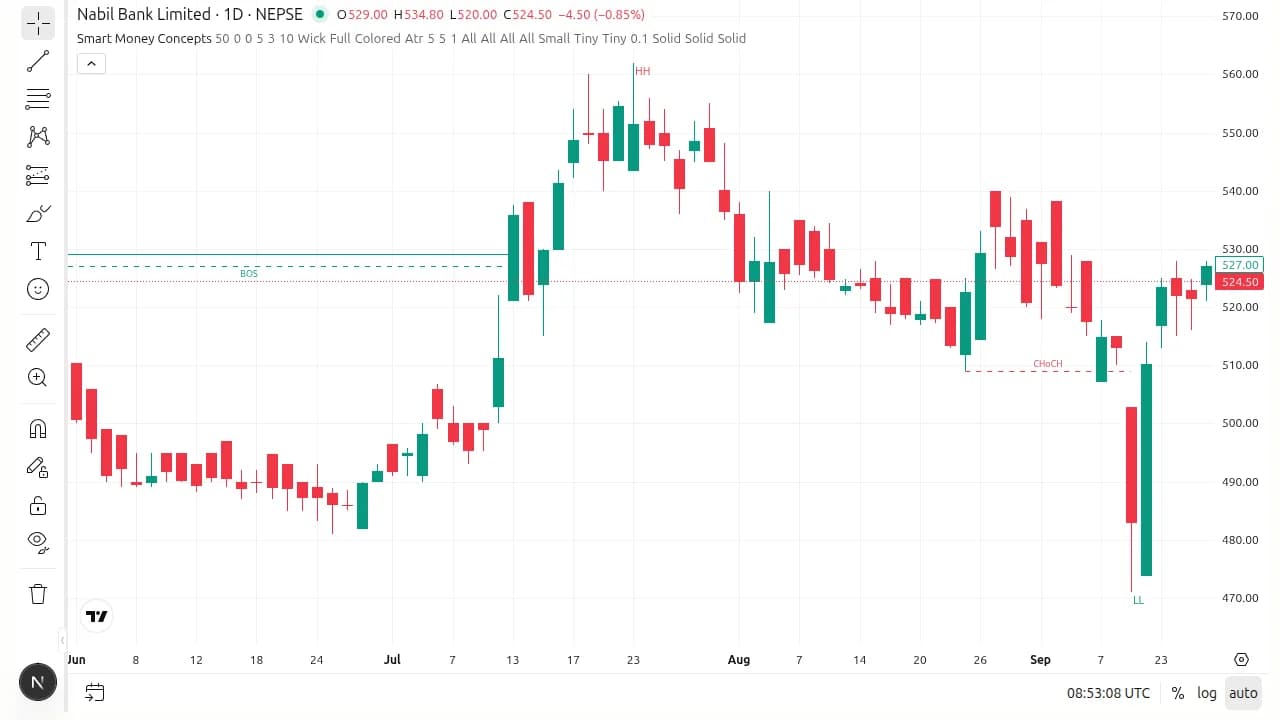
A red CHoCH line marks the first break against an uptrend; the prior demand blocks then failed one by one.
Not financial advice. For research and education only.